A house with plenty of exits
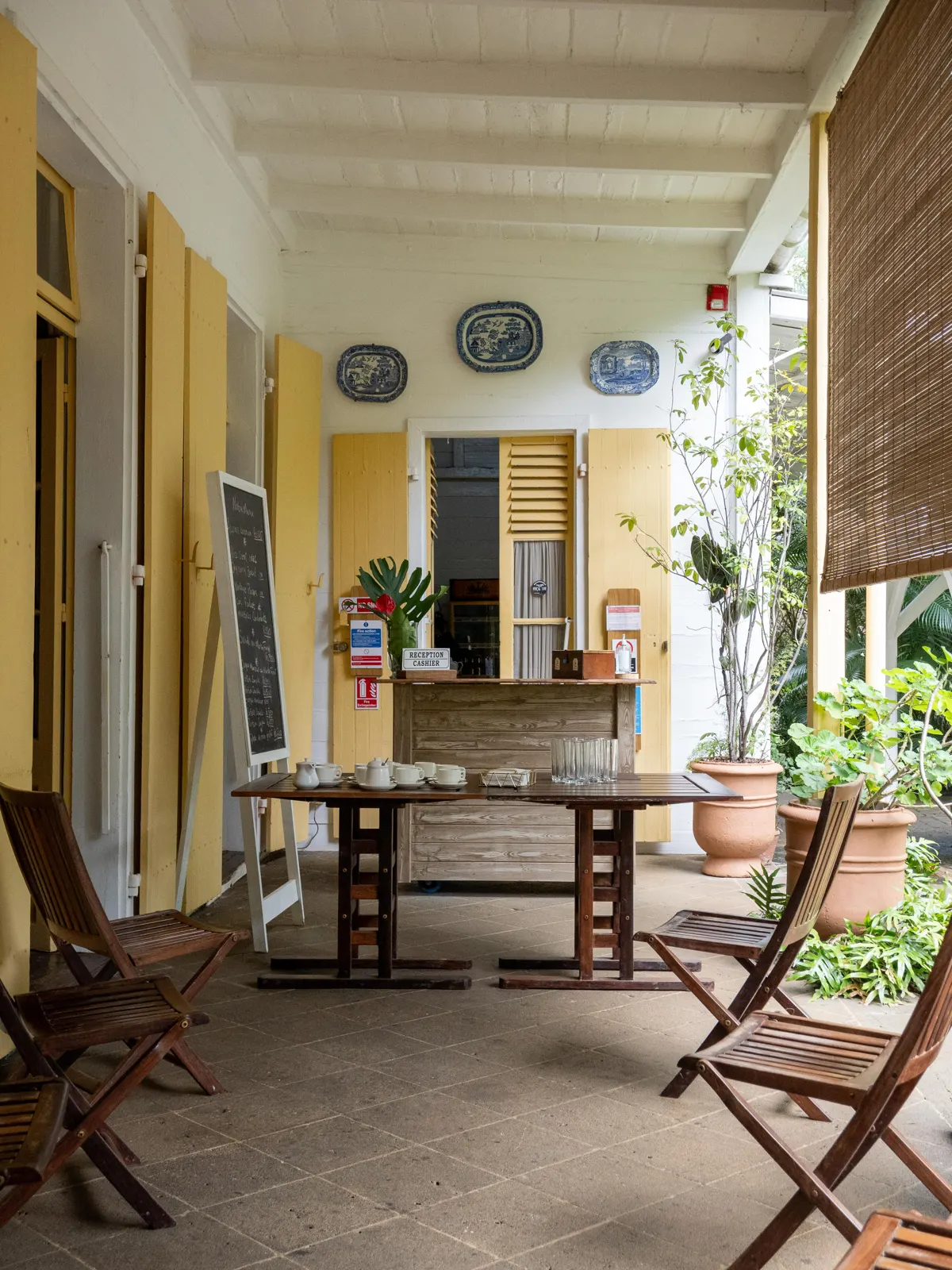
Our day inland began at Eureka House in Moka. We walked through furnished rooms and along the veranda, photographing polished floors, a piano, dining furniture and beds draped with mosquito netting. The bathroom fittings earned their own close-ups. Domestic life leaves some wonderfully specific objects behind.
Eureka dates from the 1830s and is known for its 109 doors and windows. That is a considerable number of openings to check before going to bed. The wooden house is now a museum, preserving a view of affluent domestic life in colonial Mauritius. Source: Le Défi, colonial heritage.
The house’s survival has its own family plot. Eugène Leclézio acquired Eureka in 1856, beginning its long association with the Le Clézio family. A history reproduced by Vintage Mauritius from the house’s former official website records that Simone Leclézio died in 1980, leaving Eureka to Fernand Leclézio, while the wider fortune was shared among a family of 104 nephews and nieces. That is enough relatives to make even a house with 109 openings feel short of private corners. Source: Vintage Mauritius, historical account credited to Maison Eureka.
Fernand sold the property to developers in 1985. Jacques Planteau de Maroussem, known as Jacky, then bought it back with his wife and in-laws. His connection to the Le Clézio family came through his wife’s family. A 2023 profile in La Gazette describes how they opened Eureka to the public in 1986 to help pay for renovations. The museum and restaurant were therefore part of the practical solution to keeping the house standing. Source: La Gazette, interview with Jacques de Maroussem.
There is a more personal twist to the ownership story. Travel writer Dawn Jorgensen recalls meeting Jacques at Eureka and hearing him explain that he had come to own the property through what he called “a good divorce”. It is a memorable detail from the owner’s own storytelling, reported by a visitor, rather than a published account of the settlement’s terms. Between inheritances, developers and a marriage ending, the house’s history has been anything but static. Source: Dawn Jorgensen, The Incidental Tourist.
That changes how the rooms read. The furniture tells us about the people who once lived here; the open doors also tell us about the people who found a way to keep the place going. Preserving a family house this size requires rather more than inheriting the keys.
The veranda and repeated doorways are as interesting as the furniture: they frame the garden again and again, making the outside part of the view from within. Our gallery follows those openings through the house, then out into the greenery and the old kitchen area.
It is worth keeping the scale of this household in mind. A grand dining room and carefully furnished bedrooms show how a wealthy family lived; they cannot stand in for everyday life across the island. Looking at the kitchen alongside the formal rooms brings the work of running such a house back into the picture.
A crater with another life
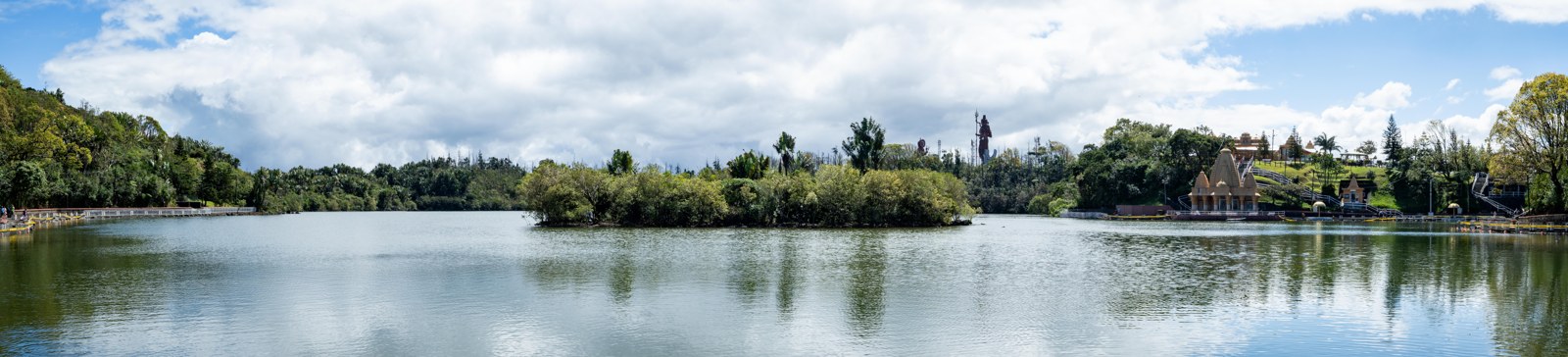
At Grand Bassin, also called Ganga Talao, our photographs move from the monumental statues at the approach to shrines, offerings, incense and people taking part in worship. Then the view opens onto the lake. Fish gather near the surface; monkeys appear among the trees. There is plenty happening before we even consider the landscape itself.
This sacred Hindu lake occupies a volcanic crater. Its connection with the Ganges is religious and symbolic: in 1972, water brought from the Indian river was ceremonially added to the lake. A little water carried across an ocean helped express a much larger connection between places. Background: an ethnographic account published by Göttingen University Press.
Two giants at the entrance
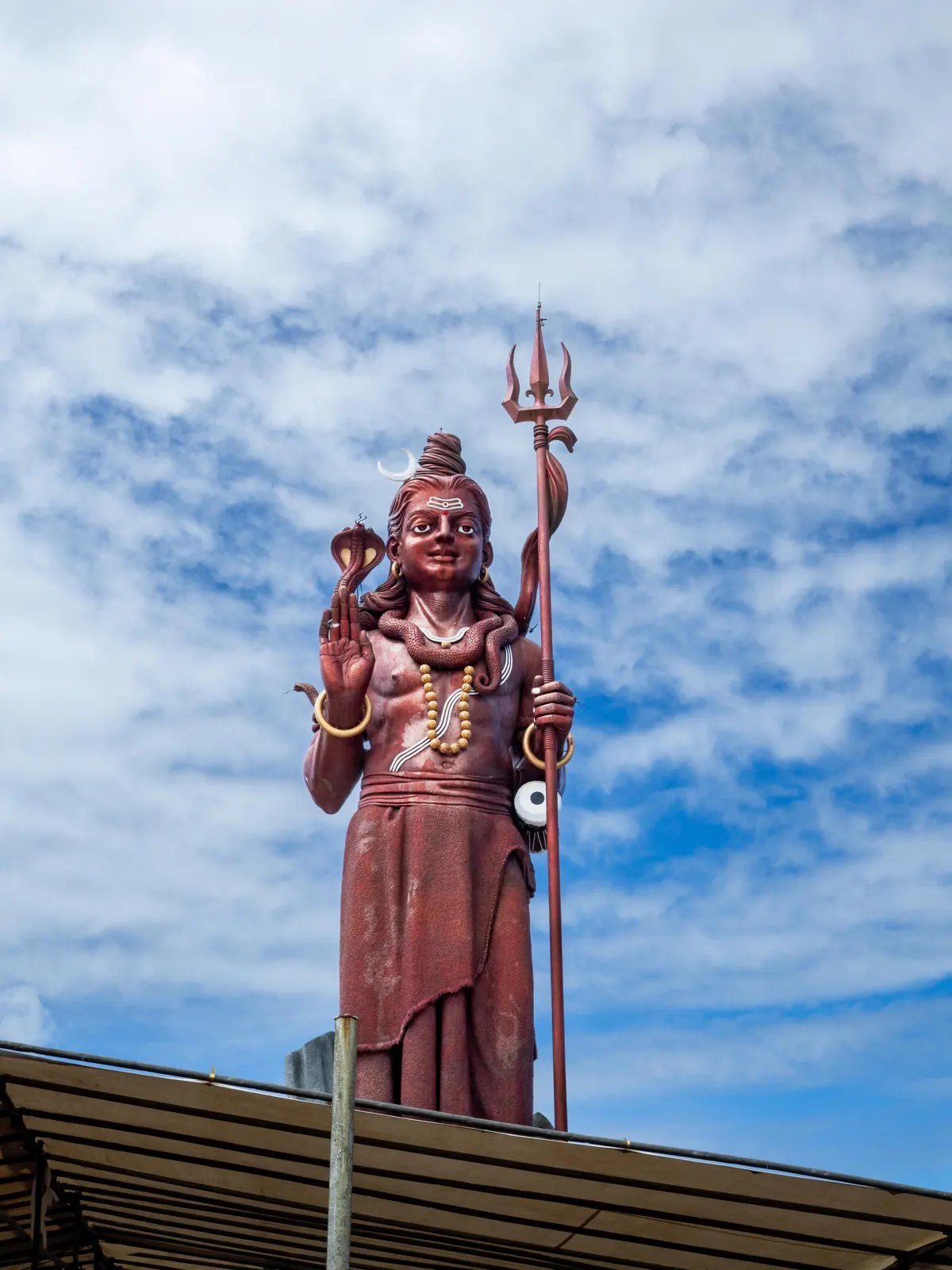
The monumental figures at the approach are Shiva, in the form known as Mangal Mahadev, carrying his trident, and the many-armed goddess Durga beside her lion. Both stand about 33 metres tall, or 108 feet. Durga represents divine protective power; her many arms express her ability to act in several ways at once. The lion reinforces that association with strength.
The record needs a little precision. At Durga’s consecration in 2017, Mauritian reporting described her as the world’s tallest statue of Durga. That is a claim about this particular goddess, rather than all Hindu statues. Source: Le Mauricien, Durga’s consecration. Shiva statue: Mangal Mahadev.
Shiva, and the blue throat
Shiva is one of Hinduism’s major deities. He is often described as the destroyer or transformer: destruction here belongs to a cycle in which things end and life is renewed. He is also represented as a meditating ascetic and as a family figure with his wife Parvati. A trident, a third eye and a crescent moon are among the attributes that help identify him.
The blue colouring has a story behind it. In the tradition of the churning of the cosmic ocean, a deadly poison emerges before the nectar of immortality. Shiva takes the poison to protect the world, holding it in his throat, which turns blue. This gives him the name Nilakantha, “the blue-throated one”. Some images show much more of his body in blue, but it is specifically the throat that this account explains. Source: Encyclopedia of India–China Cultural Contacts.
How Ganesha acquired an elephant’s head
The elephant-headed deity Ganesha is the son of Shiva and Parvati, associated with wisdom and the removal of obstacles. In one widely told Hindu account, Parvati creates a boy and asks him to guard her doorway while she bathes. When Shiva returns, the boy refuses him entry. Shiva, not recognising him as Parvati’s son, becomes angry and cuts off his head.
Parvati is devastated and demands that the boy be restored to life. Shiva replaces the lost head with an elephant’s and revives him. The details differ between traditions, but this is the familiar explanation for Ganesha’s unmistakable appearance. Knowing the story gives the elephant head a very different meaning from a purely decorative feature. Source: UCLA, Ganesh.
The macaques between the shrines
Our Grand Bassin gallery also follows a much smaller cast: macaques on the ground and among the branches, including adults with young. These are long-tailed macaques, Macaca fascicularis, an introduced species in Mauritius with its native range in Southeast Asia. They live in social groups and eat a varied diet, including fruit and other plant material as well as small animals. Their other common name, “crab-eating macaque”, sounds rather more specialised than their actual menu. Source: Wisconsin National Primate Research Center.
They give the photo sequence a change of scale: from a 33-metre deity to a youngster held close against an adult. These are wild animals sharing a busy visitor site, so the sensible way to watch them is with a little distance and food kept out of reach.
The close-ups give this stop its character. The statues establish the scale; the offerings show how the place is used. A photograph of the lake alone would leave out much of what we actually saw.
Following the cane
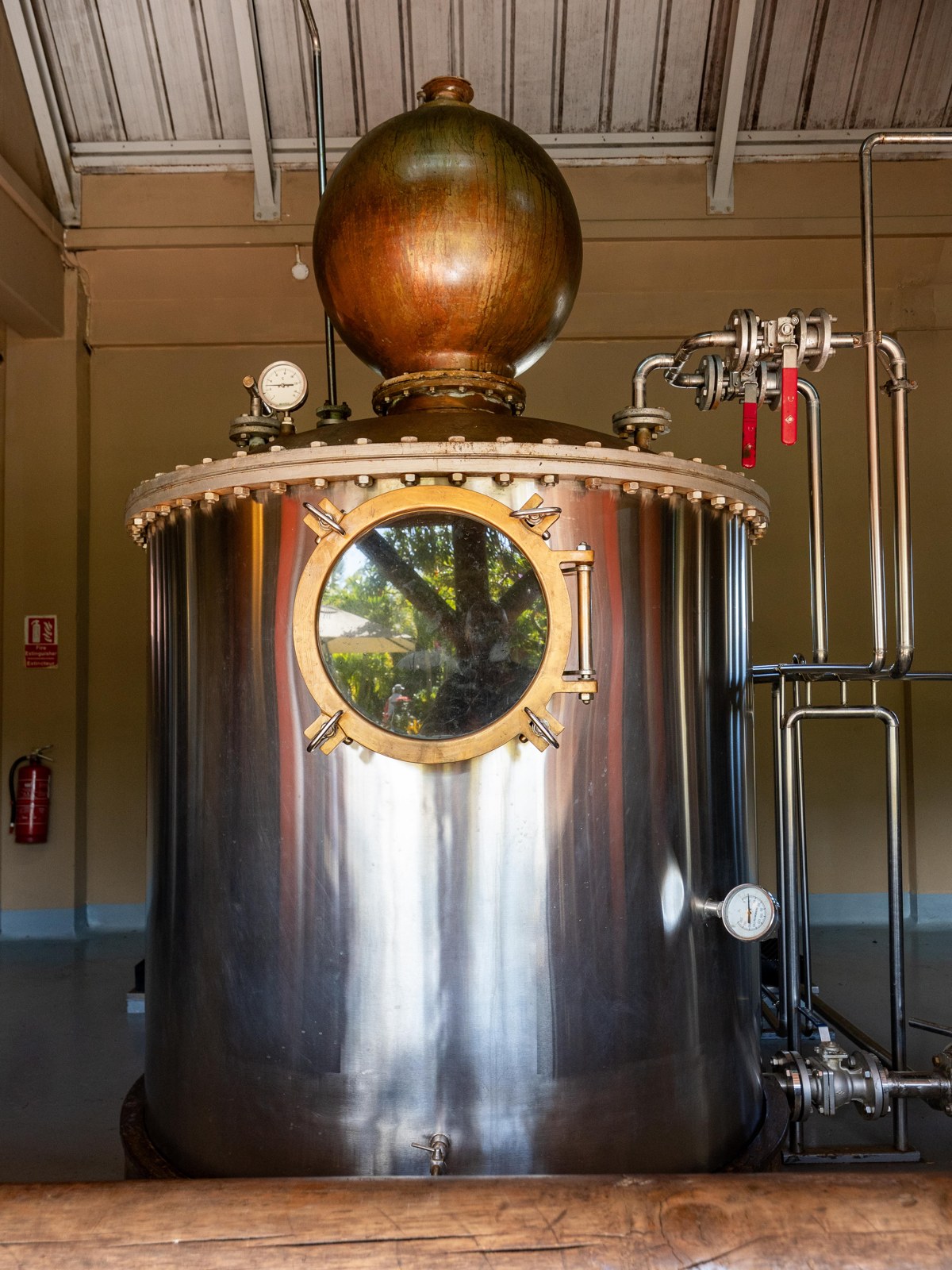
After a stop at the Black River Gorges viewpoint, the photo sequence takes us to the Rhumerie de Chamarel. Gardens and water features frame the entrance, but inside, the machinery takes over: cane handling equipment, tanks, pipework and copper apparatus.
First, squeeze the stalk
The machinery starts with a simple task: extracting the sweet juice held inside the cane. Rollers crush the stalks, separating the liquid from the fibrous remains, called bagasse. That fibre can be used as fuel at sugar mills—one crop supplying both a product and some of the energy needed to process it. Source: The Sugar Association.
Where syrup and molasses fit in
To make cane syrup, the extracted juice is clarified and heated so that water evaporates. The sugars become more concentrated and the liquid thickens. Concentrating sweetness is the aim at this stage; no alcohol has been created.
Sugar manufacture takes the process further: the concentrated juice forms crystals, which are separated from the remaining liquid in centrifuges. The dark, sugar-rich liquid left after sugar extraction is molasses. Cane syrup and molasses therefore have different histories: syrup is concentrated juice, while molasses is what remains after sugar crystals have been taken out. Source: sugar refining and processing.
Rum can begin with fresh juice, cane syrup or molasses. Syrup and molasses are diluted to a suitable concentration before fermentation. Chamarel takes the fresh-juice route, so making syrup is not an intermediate step in the production we visited. Background: FAO, sugarcane fermentation products.
Yeast does the transforming
Fermentation is where the alcohol appears. Yeast consumes sugars and produces ethanol, carbon dioxide and flavour compounds. The result is a relatively low-strength fermented liquid, sometimes called cane wine or a wash. The choice of yeast and the fermentation conditions help shape its aroma. Boiling sweet juice alone would simply make it more concentrated; yeast supplies the chemical transformation. Source: Alimentarium, sugar cane and rum.
Chamarel says its cane is harvested by hand without burning, then pressed close to the fields. The filtered juice goes into open stainless-steel fermentation tanks. Freshness matters here because this route starts with the juice itself.
From fermented juice to rum
Distillation then concentrates the alcohol and selects aromatic components. Heating the fermented liquid produces vapour richer in alcohol than the original wash; cooling that vapour turns it back into liquid. The still is separating and concentrating alcohol already made during fermentation. Background: fermentation and distillation.
Chamarel uses both a copper column for continuous distillation and copper pot stills for batch distillation. With the pot stills, the distiller separates the earlier and later fractions—the “heads” and “tails”—from the desired middle portion, the “heart”. Those choices help determine what reaches the finished rum.
Time, water and wood
The distillery describes a resting period in stainless steel and gradual dilution with water to reduce the strength. Selected rums then mature in oak barrels, where the spirit interacts with the wood and air. Casks are eventually selected and blended before bottling. Some liquid evaporates during ageing: the traditional “angels’ share”. Even a locked barrel has someone taking a drink. Source: Rhumerie de Chamarel, production process.
Our photographs follow that transformation through the equipment. They also include a bright green gecko on a timber post: a small interruption in an otherwise very industrial sequence, and apparently the only visitor dressed to match the gardens.
Two ways to see old lava
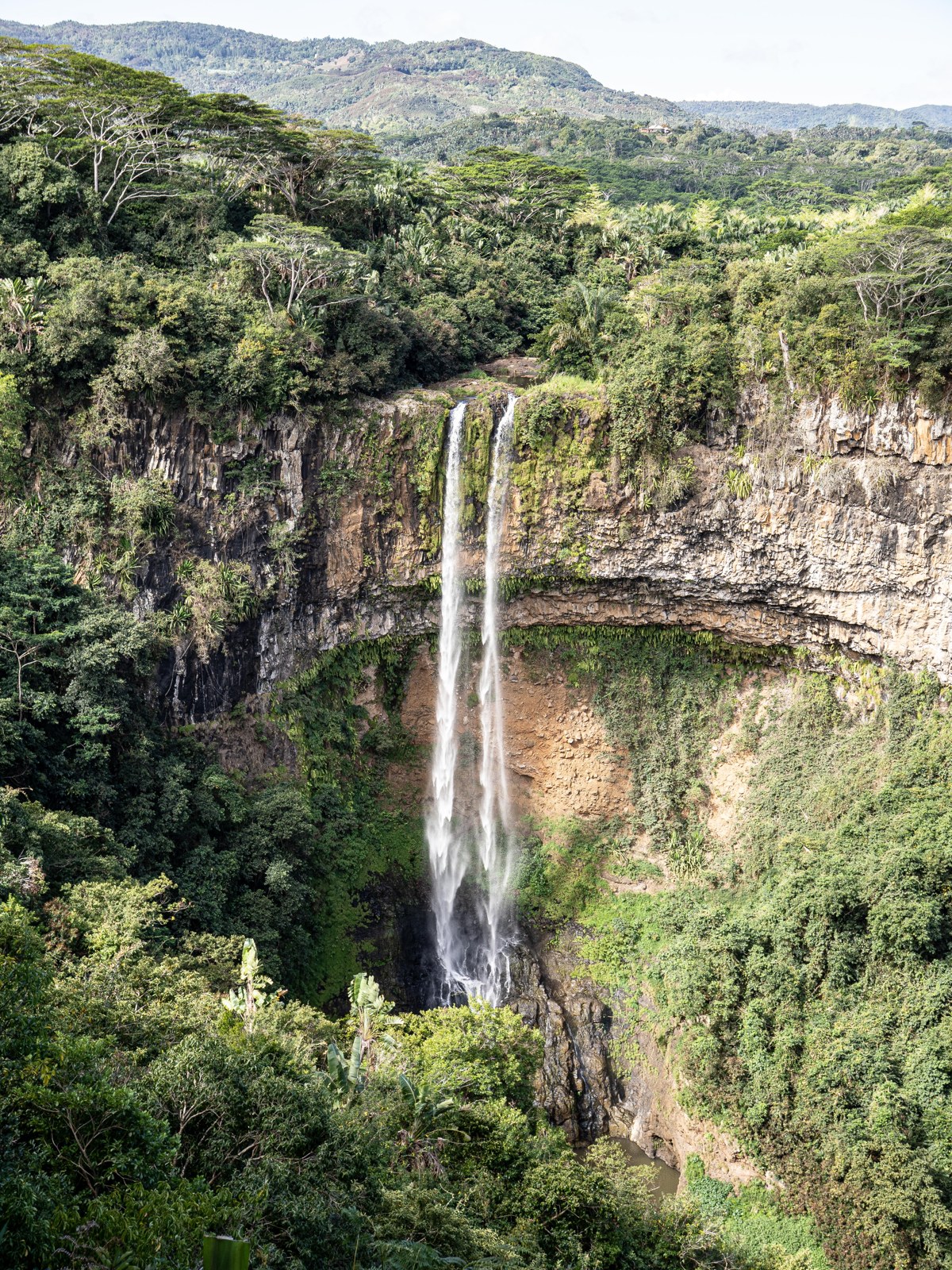
The waterfall came next. From the viewing area, the water forms pale vertical lines against a broad rock face, surrounded by green vegetation. The cliff deserves a second look: the geopark describes two episodes of lava formation exposed here, with older basalt below a younger layer. The drop is roughly 100 metres. A waterfall photograph is also, in this case, a photograph of the island’s construction history. Source: Chamarel Geopark.
A short journey onwards brought us to the Terre des Sept Couleurs. Here, the camera turns down towards folds of bare earth: rusty browns, ochres and purples, with the colours changing in prominence across the frames.
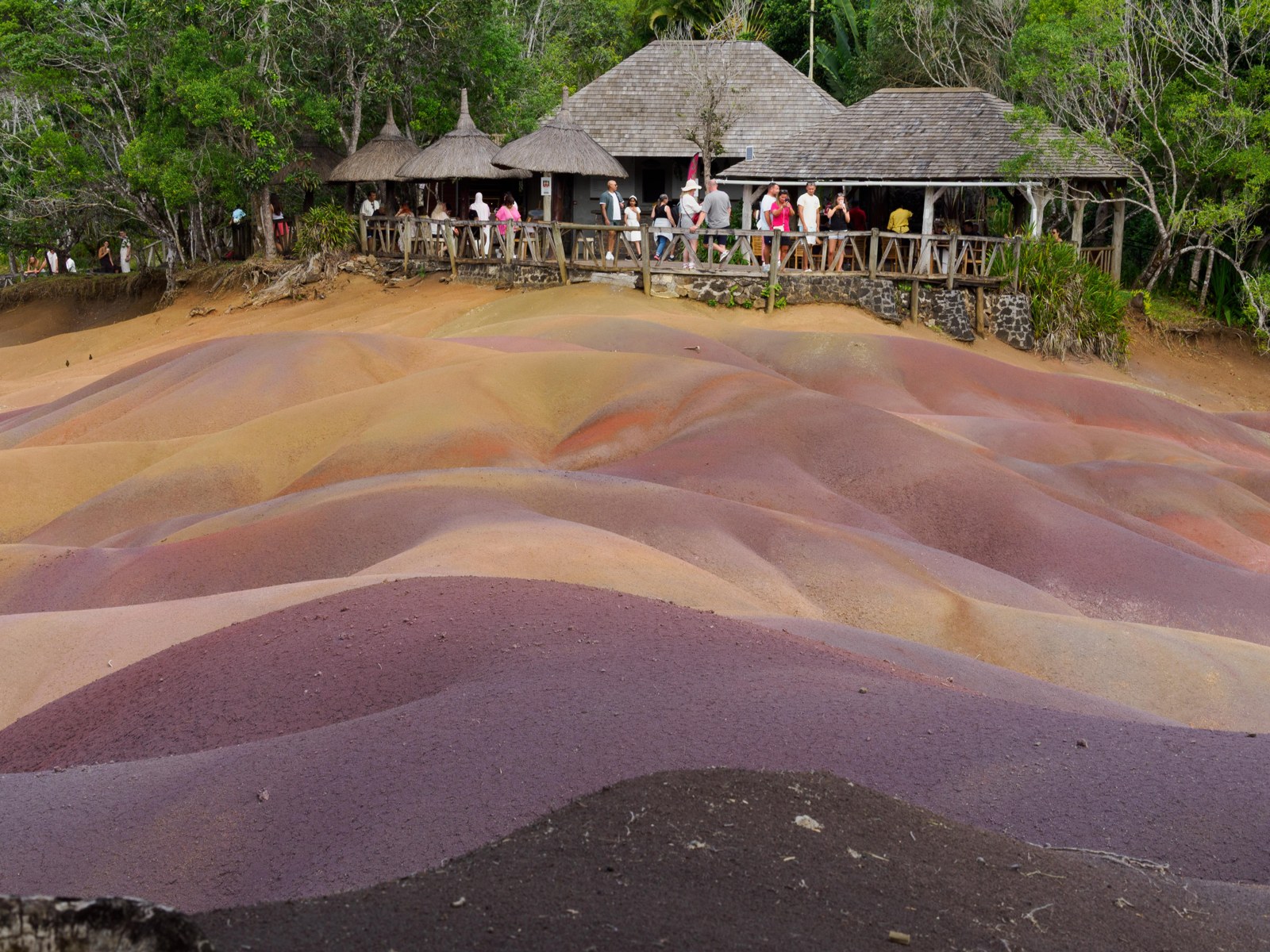
These formations developed as volcanic basalt weathered under hot, humid conditions, leaving mineral-rich soils containing iron and aluminium oxides. Rain helped carve the surface into its present shapes. The reds and browns are an especially visible reminder of iron chemistry at work. Source: the geopark’s geological history.
“Seven colours” invites a counting exercise, but the photographs show gradients rather than seven neatly separated paint samples. The interesting part is the combination: exposed, rippling earth beside dense greenery, all produced through the long interaction of rock, climate and water.
We also photographed the giant tortoises kept at the site. These are Aldabra tortoises, whose native home is in the Seychelles—a useful reminder that an animal encountered in Mauritius is not automatically a Mauritian native. Source: Chamarel Geopark.
At market-stall distance
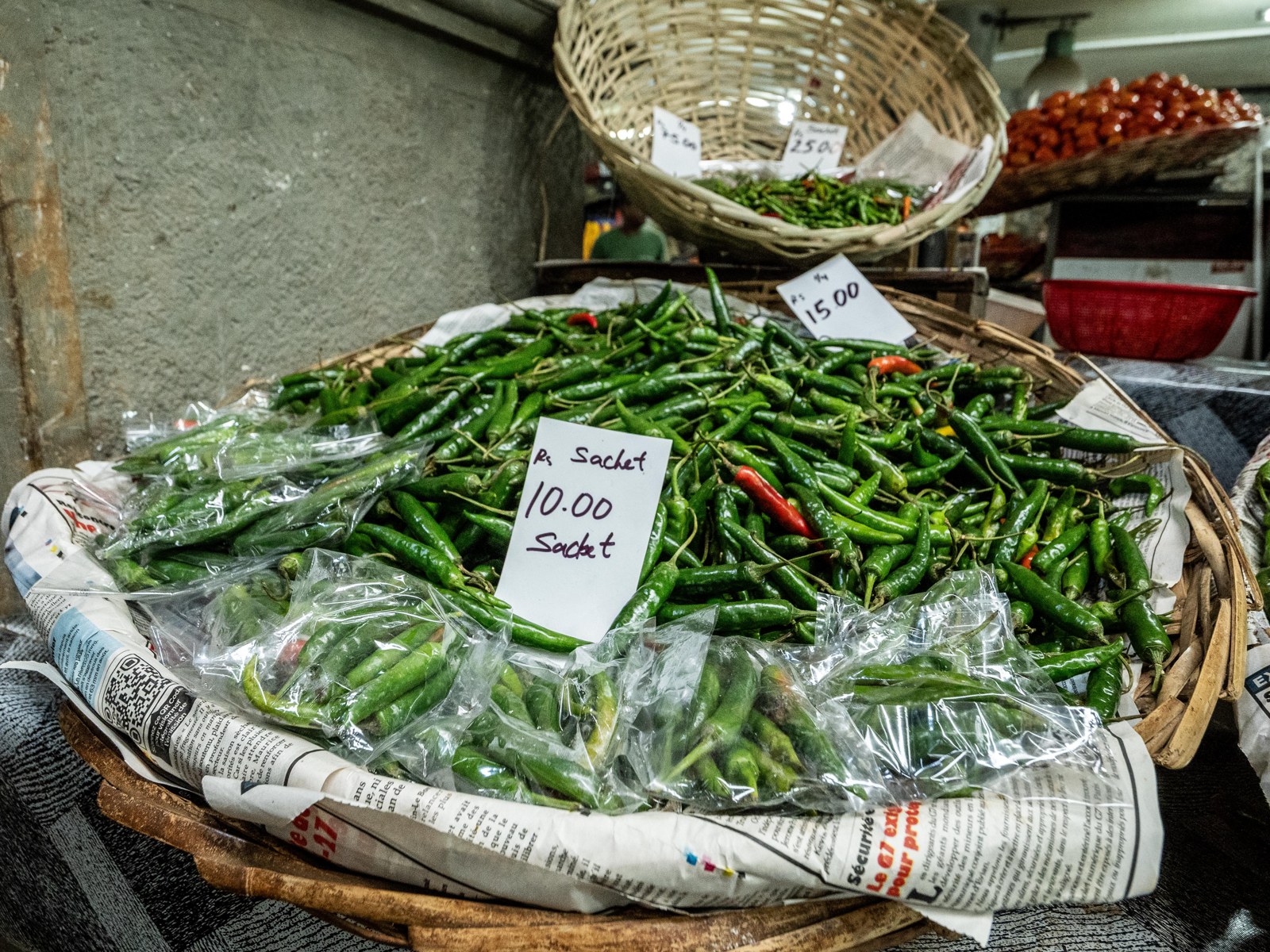
Port Louis changes the scale again. In the Central Market, our photographs linger on stacked vegetables, bags of chillies, knobbly roots, cut stems and peeled pineapples individually wrapped for sale. Above them are signs and prices; between them, narrow aisles full of people.
The prepared pineapples look almost sculptural. A photograph cannot tell us how they tasted, but it can record the work already done to turn a difficult, spiky fruit into something ready to carry away. The same attention to detail makes the vegetable stalls worth looking at: how things are stacked, portioned, labelled and displayed.
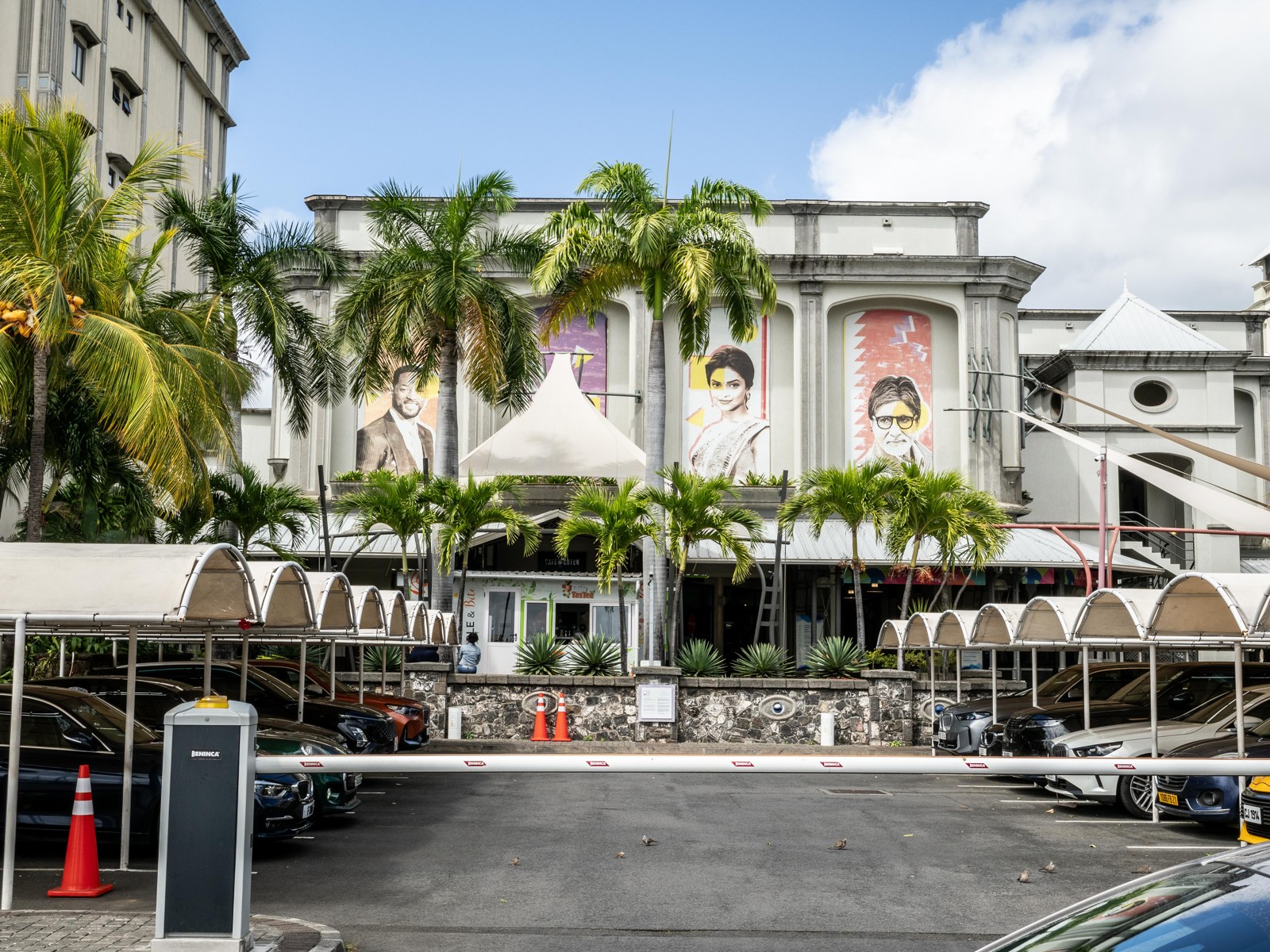
Outside, the sequence follows shopfronts, scooters and busy streets before returning to the harbour and Le Caudan Waterfront. Its umbrella-covered passageways and open waterside spaces give the camera much more room. Caudan opened in 1996: despite the historic harbour setting, this shopping and leisure complex belongs to a relatively recent chapter of Port Louis. Source: Le Caudan Waterfront.
The harbour also carries a deeper history. At Aapravasi Ghat, elsewhere on the Port Louis waterfront, almost half a million indentured labourers from India arrived between 1834 and 1920, to work in Mauritius or travel onwards. That history gives context to the island’s connections with India and to the labour behind its sugar economy. This is background to our city visit; our photographs do not establish a visit to the site itself. Source: UNESCO.
A landmark with a working vocabulary
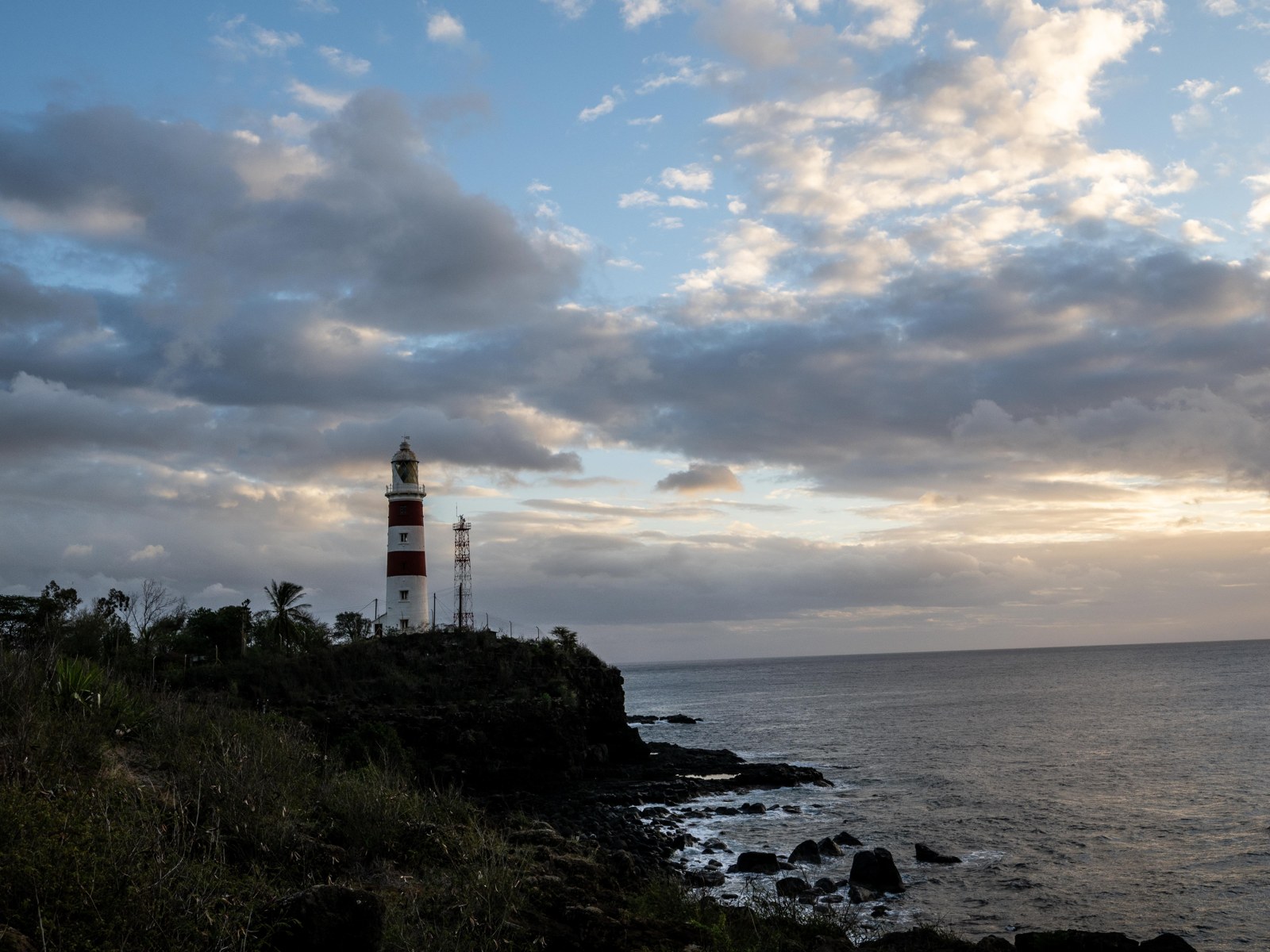
At Albion, we photographed the red-and-white lighthouse from the surrounding coastal ground. The sequence moves between close views of the tower, rough rock at the water’s edge and wider frames beneath a changing sky. The building stays easy to pick out even when it occupies only a small part of the photograph.
Its navigational name is Pointe aux Caves. The Mauritius Ports Authority lists its light characteristic as “Fl (2) W 10s”: a group of two white flashes repeated every ten seconds. A lighthouse has a recognisable rhythm as well as a recognisable shape—effectively a name that can be read in the dark. Source: Mauritius Ports Authority, Marine Section.
From land, the tower provides a fixed point for the composition. At sea, identifying that fixed point is the practical purpose. The rocks in the foreground make the distinction quite clear: this attractive coastal subject also belongs to the business of knowing where your boat is.
Our visit stayed outside. The gallery follows the lighthouse from several angles, including the lantern, the surrounding ground and the coastline, rather than implying a climb inside the tower.
The hands become useful
The Seven Cascades, also known as Tamarind Falls, are near Henrietta. They are a separate waterfall system from Chamarel Falls, which we had visited on 27 August. Location reference: Seven Cascades.
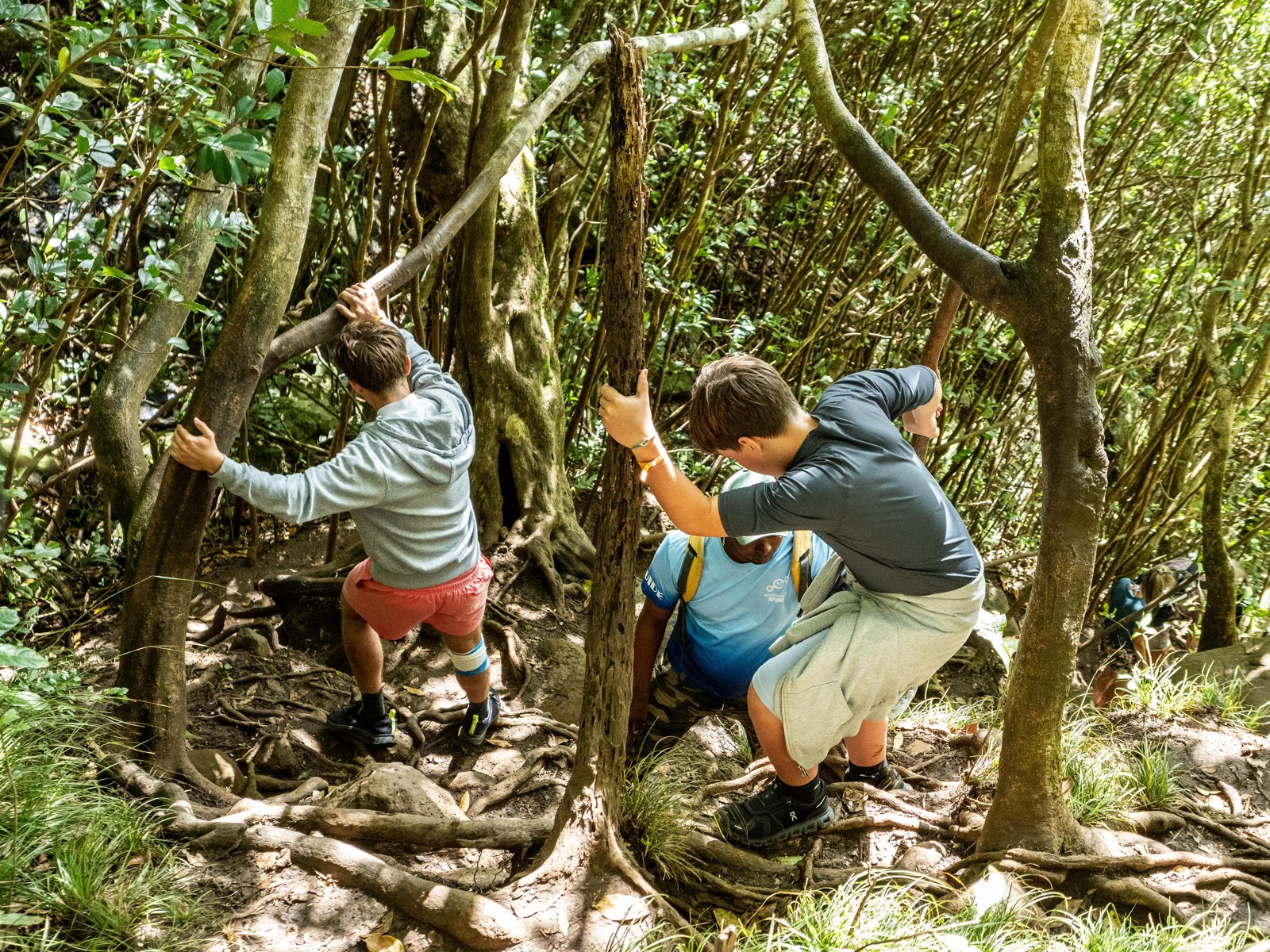
The photographs make the difference immediately clear. At Chamarel, we stood at a railing. Here, we descended through trees, stepped over rock and used roots and branches as handholds. Several frames show the practical business of getting down a slope rather than posing at the end of it. Walking had become an activity for four limbs.
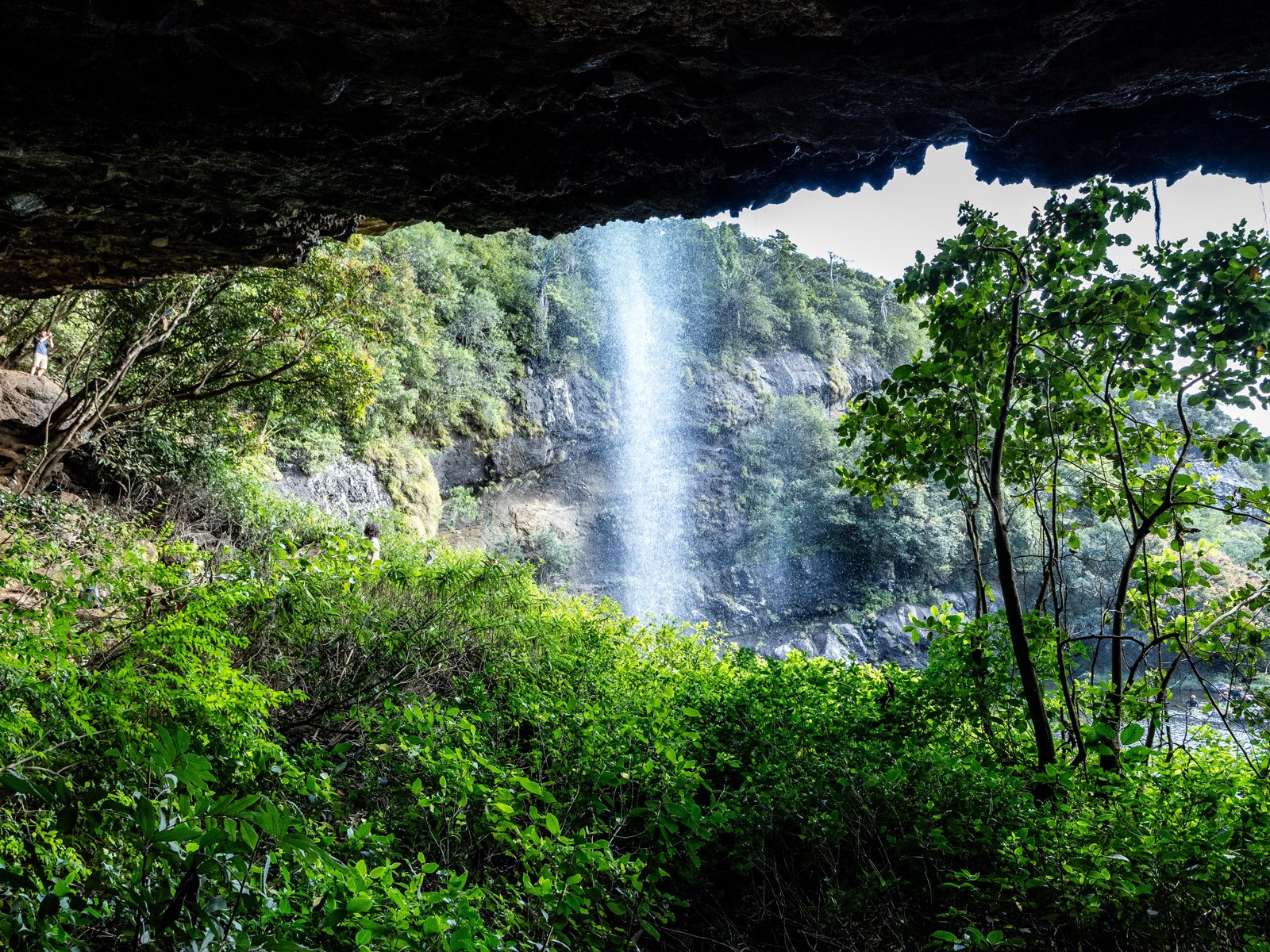
The sequence takes us from views over the gorge to pools, ledges and the base of a waterfall. One photograph looks out from beneath a dark rock overhang, with water falling beyond it. We had moved inside the scene that a distant viewpoint compresses into a single image.
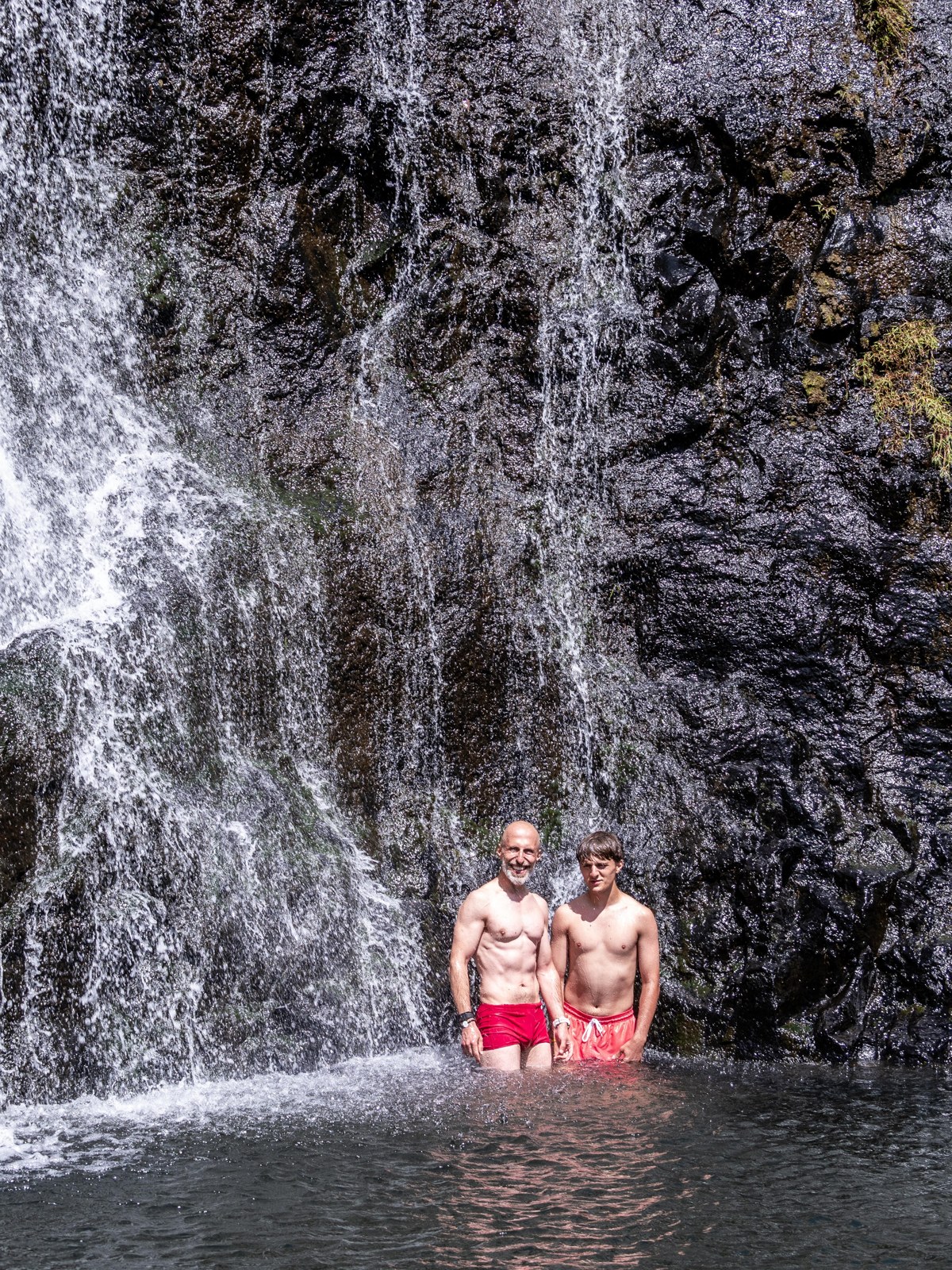
Later photographs show us in the water beneath a cascade. After all the careful footwork on the descent, the sequence finally exchanges walking shoes and handholds for a pool and falling water.
The final hiking frames return to narrow paths and then open ground. In between are the details that give the day its shape: a hand around a branch, people resting beside a pool, a curtain of water seen from behind. After all the wide views, those are the images that explain what visiting the waterfalls involved.